
Reviewed · SALEM TOURS
Salem Bewitched Tour With Tarot Reading
Tarot cards meet Salem’s witch trial walls. I like how the walk stitches together heavy history and TV pop culture, and the tarot reading makes it feel more than just a facts-and-photos stop. With a maximum group size of 6, you get room to ask questions, but plan for two sights where extra admission may be needed, especially the Witch House.
One guide, Cynthia, gets special mentions for a cheerful, clear style and strong English plus multilingual skills. The whole experience runs about 2 to 3 hours, it’s designed for a moderate walking pace, and it returns you to the starting point at Peabody Essex Museum.
In This Review
- Key highlights you’ll actually feel during the tour
- A Salem walking loop that fits an afternoon or evening
- Starting at Peabody Essex Museum, where the mood can change fast
- Pickman House stories that set the tone before the Witch Trials Memorial
- The memorial’s granite wall, victims’ names, and why that design matters
- Old Burying Point Cemetery: Salem’s oldest preserved final resting ground
- Old Town Hall in 1816: Federal style, Palladian windows, and community use
- The Bewitched statue of Elizabeth Montgomery: the pop culture turn
- The Witch House: Jonathan Corwin, the court of Oyer and Terminer, and the moved building
- Turner’s Seafood at Lyceum Hall and the Bridget Bishop link
- Roger Conant statue: Salem’s English settlement founder in bronze
- Peabody Essex Museum tarot and palm reading: where it all clicks together
- Who this tour suits best (and who should pick something else)
- Should you book the Salem Bewitched Tour with Tarot Reading?
- FAQ
- How long is the Salem Bewitched tour with tarot reading?
- Where does the tour start and where does it end?
- What language options are available?
- Is the tarot reading included in the tour price?
- Is admission included for every stop?
- How large is the group?
- Is the tour accessible for people with limited mobility?
- Is free cancellation available?
- Is the tour ticket mobile?
Key highlights you’ll actually feel during the tour

- Small group, big attention so the guide can slow down when something matters to you
- Witch Trials Memorial stop with carved granite details, victims’ names, and execution dates
- Witch House context tied to the court that convicted the accused
- Bewitched photo moment with Samantha Stephens statue, plus Salem’s 1970 filming nod
- Tarot and palm reading by a guide trained in tarot, numerology, and palmistry
- Most stops have free admission, with a couple likely exceptions you should plan for
A Salem walking loop that fits an afternoon or evening
This tour is built for people who want Salem without spending half the day bouncing between ticket lines. You cover the Salem Witch Trials Memorial area, major downtown landmarks, and the sites tied to famous names from 1692. Then the mood shifts, because you finish with a tarot and palm reading at Peabody Essex Museum.
The pacing is tight but not frantic. You get multiple short stops, each with enough time to look, listen, and take photos when it makes sense. That’s a big deal in Salem, where even a small delay can snowball fast in a tourist-heavy area.
Two practical notes help you enjoy it more. First, it’s a walking tour with a moderate physical fitness level, so wear comfortable shoes. Second, you will likely hit one or two places where admission is not included, so keep a little extra budget ready.
More time up in Salem:
- History and Hauntings of Salem Guided Walking Tour★ 5.0 · 14,564 reviews
- Salem’s Best Ghost Tour★ 4.5 · 4,186 reviews
- Salem Voodoo, Vampires, and Ghosts Guided Walking Tour★ 5.0 · 1,931 reviews
Starting at Peabody Essex Museum, where the mood can change fast
You meet at Peabody Essex Museum, 161 Essex St in Salem. That matters because the museum is a solid “anchor point” for getting your bearings, especially if you’re arriving by public transportation.
Even though the tarot and palm reading happens at the museum end of the tour, the location sets expectations. You’re not just walking through a spooky-themed district. You’re moving through layers of Salem, from 17th-century persecution to pop culture that Salem proudly adopted decades later.
This is also where you’ll likely notice the tour’s structure. The experience uses a mobile ticket, so you can keep everything in your phone and stay focused on the streets, not the paperwork.
Pickman House stories that set the tone before the Witch Trials Memorial
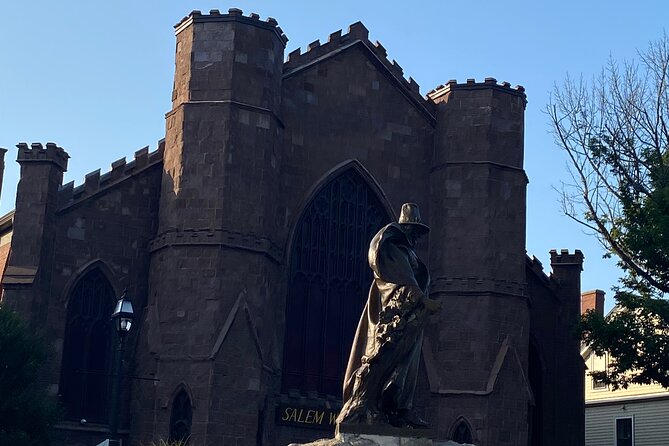
The first major stop is the Salem Witch Trials Memorial, but you don’t go there cold. You start with a stop at the Pickman House, one of the oldest houses in Salem, where the guide shares stories tied to the location.
That “prelude” works. It helps you understand why this memorial is emotionally intense, not just historically important. It also trains your eyes. You learn what to watch for before you reach the granite.
Then you arrive at the Witch Trials Memorial. It’s designed for all ages, and it uses space to make the story hit harder. On three sides, it’s surrounded by a handcrafted granite wall. As you enter, the victims’ protests of innocence are inscribed into the stone threshold. Inside, benches bear the names and execution dates of each of the 20 victims.
This is the kind of stop where you’ll want to take a slow minute. Don’t rush past the inscriptions. If you remember one thing from the whole tour, make it the names and dates.
The memorial’s granite wall, victims’ names, and why that design matters
A memorial isn’t just a plaque. This one is built like a statement. The three-sided granite wall gives you an enclosed feeling, and that matters because witch trials were, at their core, about trapping people inside accusations.
The inscribed protests of innocence at the threshold make you look at the victims first, not the judges or the loud claims. Then the benches with each victim’s name and execution date turn the tragedy into something specific. You’re not seeing a vague dark chapter. You’re seeing 20 lives, listed and dated.
If you’re bringing kids, the memorial’s age-friendly layout helps. It’s not a maze or a scavenger hunt. It’s a clear, walk-in space where the guide can explain what you’re looking at without needing you to decode anything complicated.
Timing is tight here, about 15 minutes for the memorial itself. So if you like to read every line, give yourself a plan. Look first for the names, then read the protests, then snap one photo if you want it for memory.
Old Burying Point Cemetery: Salem’s oldest preserved final resting ground
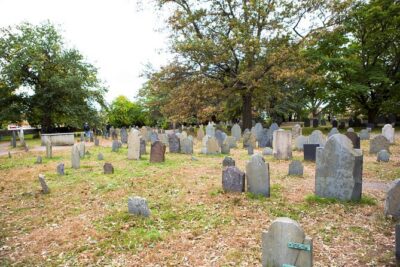
Next you head to Old Burying Point Cemetery, also known as the Charter Street Cemetery. It’s the oldest maintained cemetery in Salem and among the oldest in the United States, opened in 1637.
This stop is brief, around 5 minutes, and it’s best treated like a pause. Cemeteries work differently than museums. You don’t need to speed-read. You just need to be respectful and present.
You’ll also get context for why Salem treats these grounds as part of its identity. The cemetery is the final resting place of several Salem notables. That adds a different angle to the witch trials story. Salem’s fear and conflict were real, but the town’s long timeline didn’t stop in 1692.
If you want a practical tip: use this stop to reset your brain. Witch trial sites can feel emotionally heavy. The cemetery gives you a quieter rhythm.
Another way the same afternoon could go around Salem:
Old Town Hall in 1816: Federal style, Palladian windows, and community use
Then it’s Salem Old Town Hall, a Federal style brick building erected in 1816. The building is also the namesake of the Old Town Hall National Historic District.
This stop is another quick one, about 5 minutes, but it’s a useful contrast to the memorial. Instead of focusing on punishment and accusations, you’re looking at the later civic face of Salem. The two-story building has Palladian windows, carved wood details, antique chandeliers, and decorative columns with hardwood floors.
Here’s a key detail that makes this more than just “pretty architecture.” The Old Town Hall is no longer used for municipal operations. Today it functions as a cultural and rental facility in service to the community of Salem.
That’s worth noticing because it tells you Salem doesn’t just preserve the past. It keeps using the buildings, which helps history stay alive instead of turning into a display case.
The Bewitched statue of Elizabeth Montgomery: the pop culture turn
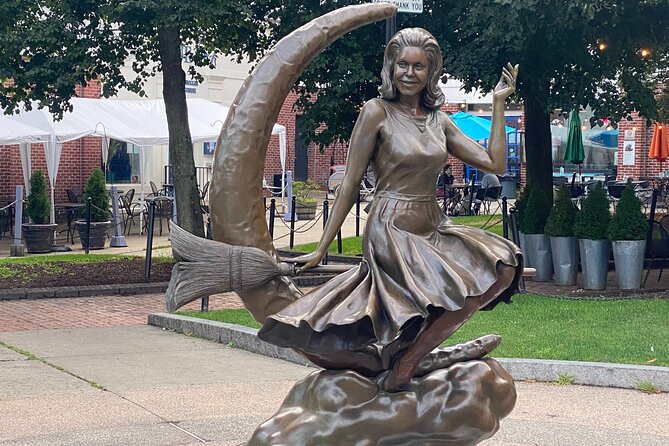
Now the tour pivots, and it pivots on purpose. You spend time at the Bewitched statue of Elizabeth Montgomery, a six-foot bronze sculpture.
The statue depicts Samantha Stephens, the character Montgomery played in the 1960s sitcom Bewitched. She’s sitting sidesaddle on a broom next to a crescent moon. Several episodes of the show were filmed in Salem in 1970, and Salem has embraced that TV connection ever since.
This stop is about photos, about the Salem vibe you’ll see everywhere, and about how the city reframes witch imagery. In the memorial you’re confronted with accusations and death. Here you get the lighthearted version of witchcraft, the one Salem turned into a cultural brand.
You’ll have about 10 minutes here for pictures. Bring a charged phone, wipe the lens if it’s foggy, and consider taking one photo where you include the broom and the crescent moon, not just the face.
The Witch House: Jonathan Corwin, the court of Oyer and Terminer, and the moved building
The Witch House at Salem is one of the most important stops on this tour because it’s one of the only extant buildings with direct ties to the Salem Witch Trials. It’s the home of Jonathan Corwin (1640 to 1718), uncle of High Sheriff George Corwin.
The guide gives the courtroom connection, and that part is the heart of why this building matters. Jonathan Corwin served on the court of Oyer and Terminer that convicted the witches. That court detail turns the Witch House from a historic home into a physical link to the process that led to convictions.
There’s also a surprising earlier chapter. Roger Williams lived in the Witch House before founding Providence Plantation in Rhode Island. So you’re standing in a place with layers, not a single moment frozen in time.
One more practical detail shapes what you see. The house was moved 11 meters from its past location in the 1940s to accommodate road widening. That means your mental picture of the building’s position in the original street layout needs flexibility.
This stop runs about 10 minutes, and admission is not included. Plan a little extra time if lines happen, and double-check what you need when you book, because old-site entry rules can be strict.
Turner’s Seafood at Lyceum Hall and the Bridget Bishop link
Next you stop around Turner’s Seafood at Lyceum Hall, a location tied to Bridget Bishop. Bishop, c. 1632 to 10 June 1692, was the first person executed for witchcraft during the Salem witch trials in 1692.
This is another stop where the guide brings the name to life through context. It’s easy to remember Bridget Bishop as a line in a timeline, but hearing where she was connected to helps the story feel grounded in real streets and real places.
From here, the tour continues to the site of the infamous Salem Jail. This is where people were arrested for allegedly practicing witchcraft and imprisoned before being hanged.
Even though this is not a long stop, it hits hard. It’s a reminder that trials were not abstract. They involved arrests, confinement, and executions.
If you’re the type who likes visuals, this is where you’ll appreciate being in a group. You can hear the explanation while also looking at how the space feels, which makes it easier to form a mental map.
Roger Conant statue: Salem’s English settlement founder in bronze
The Roger Conant Statue is a short but satisfying stop, about 5 minutes. You’ll see the statue of Roger Conant, founder of the English settlement in Salem.
The sculpture was made in 1913 by Henry Hudson Kitson, who is also famous for the Lexington Minuteman Memorial. That connection is the kind of detail you don’t get from quick walking tours, and it helps you see how Salem’s memory is shaped by later generations.
This stop also gives a clean change of subject. After the jail and executions, it feels like you’re stepping back to the broader story of how the settlement began.
Peabody Essex Museum tarot and palm reading: where it all clicks together
The final stop is back at Peabody Essex Museum for tarot and palm reading with the host tour guide. This guide is described as experienced in tarot, numerology, and palmistry, so expect the reading to blend those methods.
You get time for it, about 20 minutes at this stage. The tour’s included highlight is a 15-minute tarot reading from the host guide, so it’s structured, not a casual chat. That structure is good for most people. You get guidance, you’re not wandering around hoping someone notices you.
The museum stop also helps explain why the tour works as a whole. You start with accusation and conviction, and you end with symbolism and interpretation. Even if you take tarot with a grain of salt, it’s still a fun, personal way to reflect on the story you just walked through.
Admission for the museum is marked as not included for this stop. The reading itself is part of what you’re paying for, but you should confirm what is covered before you go so you don’t get surprised at the door.
Who this tour suits best (and who should pick something else)
This is a great fit if you want Salem in one organized loop that balances dark history with pop culture fun. It’s also a strong choice if you like guided storytelling, because the tour layers explanations across multiple stops instead of dumping everything at once.
It’s especially good for:
- People who enjoy hands-on interpretation, like the names, dates, and inscriptions at the memorial
- Fans of Bewitched who want the Salem connection to the 1970 filming
- Anyone who wants a short, included tarot experience rather than trying to book it separately
It might be less ideal if you want a long museum-style visit at each stop. Several stops are quick, including the Witch House and Old Town Hall. You get the highlights, not extended browsing time.
Also, if you’re sensitive to heavy topics, be prepared. This tour includes the jail site and memorial details for victims of executions. It’s handled respectfully, but the subject is intense.
Should you book the Salem Bewitched Tour with Tarot Reading?
Yes, if you want a smooth 2 to 3 hour Salem experience that connects the Salem Witch Trials Memorial, the Witch House, and the show-era Salem charm, then ends with a real tarot and palm reading.
Book it if you value organization, small group attention, and a guide like Cynthia, who is noted for being cheerful and switching perspectives in a way that makes history feel understandable. You’ll also like it if you prefer a tour that mixes places you can’t recreate on your own with a fun, personal ending.
Consider another option if you need lots of time inside each historic building, or if you dislike the idea that extra admission may apply at stops like the Witch House and possibly the museum portion. In that case, you might prefer an itinerary built for longer self-paced visits.
FAQ
How long is the Salem Bewitched tour with tarot reading?
The tour lasts about 2 to 3 hours.
Where does the tour start and where does it end?
The meeting point is Peabody Essex Museum, 161 Essex St, Salem, MA 01970. The activity ends back at the same meeting point.
What language options are available?
The tour is offered in English, French, Spanish, and Italian.
Is the tarot reading included in the tour price?
Yes. The tour includes a 15-minute tarot reading from the host tour guide, and the experience also includes tarot and palm reading during the museum stop.
Is admission included for every stop?
Most stops list admission as free, but the Witch House at Salem is marked as not included for admission. The Peabody Essex Museum stop is also marked as not included for admission, so you should confirm what is covered when booking.
How large is the group?
The maximum group size is 6.
Is the tour accessible for people with limited mobility?
The tour notes a moderate physical fitness level requirement. Service animals are allowed, and it is near public transportation.
Is free cancellation available?
Yes. Free cancellation is available up to 24 hours in advance for a full refund.
Is the tour ticket mobile?
Yes. The tour uses a mobile ticket. Confirmation is received at the time of booking.
Written up lately around the harbor
- High Witch History Walking Tour of Salem
★ 5.0 · 1 review - Haunted Salem Ghost Tour
★ 2.0 · 1 review - Multilingual Self-Guided Audio Ghost Tour in Salem
★ 5.0 · 1 review - Salem Private Half Day Tour from Boston, groups 5-6
★ 5.0 · 1 review - Family Friendly Ghostly Tales of Salem
★ 5.0 · 1 review - From Boston: Salem & Hammond Castle Semiprivate Day Trip
★ 5.0 · 1 review - Tales of Salem Halloween Guided Walking Tour
★ 4.5 · 2 reviews
Salem Tours, compared.
History and Hauntings of Salem Guided Walking Tour
Read our review →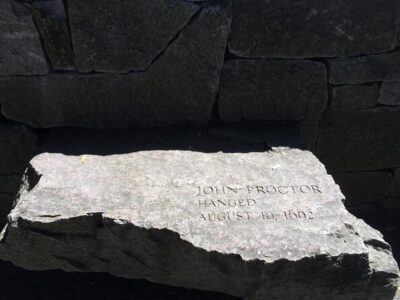


Mysteries and Murders of Salem Guided Night-Time Walking Tour
Read our review →
Wicked Awesome Tours: Witch Trial History and Salem Haunts!
Read our review →Browse the lists this tour appears in