
Reviewed · HISTORICAL TOURS
2 Hour Boston Historical and Heritage Walking Tour
History walks beside you in downtown Boston. This 2-hour heritage walk takes you through the city’s big turning points and also the smaller, human details that don’t fit neatly into postcards. I love the way Boston Common sets the stage, then the tour keeps sharpening the story at Park Street Church. I love that you can ask questions as you go, not just listen and shuffle along. The main trade-off is that it’s a walking tour in real city noise and weather, so plan to dress for wind and cold and expect the guide to talk a lot.
You start at the Boston Common Tablet at 1634 Freedom Trail, and you finish near Boston City Hall, with the last stretch landing directly across from Faneuil Hall. It’s timed for a 11:00 am start with a group size capped at 24, so you’re not fighting your way through crowds.
Bottom line: for $5, you’re buying a focused route through the heart of Boston’s history, with lots of stops that are free to access. Just go in knowing the pace is active, and on some days it can run a little longer depending on questions and conditions.
In This Review
- Key points that make this tour worth your time
- Walking in Boston history, from a pasture to a protest stage
- Park Street Church and the abolition thread you might miss
- Robert Gould Shaw and the 54th: bravery with a specific human story
- The Massachusetts State House: golden dome, public power, and public consequences
- The Brahmins Private Library: Boston’s bookish power in one pause
- Scollay Square and the West End: entertainment, romance, and a harder edge
- The Old State House: revolution in the shadow of a restored past
- Boston Massacre site, then the Tea Party night that lit a rebellion
- Irish Famine Memorial: one stop that expands Boston’s immigrant story
- Old Corner Bookstore: how Boston’s authors met, talked, and shaped ideas
- Boston Latin School and School Street’s quiet character
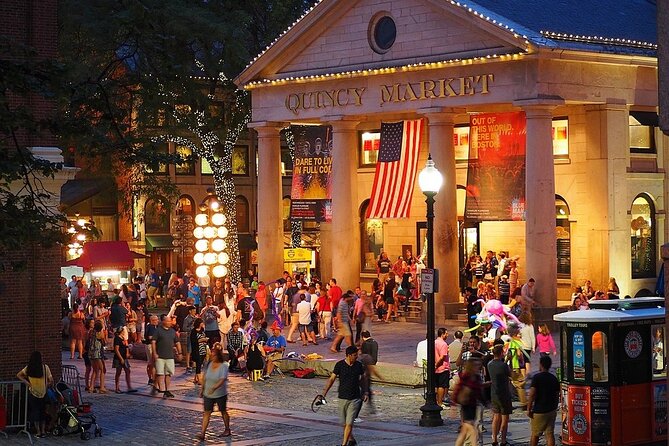
- Faneuil Hall Marketplace: the Cradle of Liberty and a weathervane detail that sticks
- Ending at Boston City Hall: James Michael Curley and a practical last stretch
- How the guide and group pace can affect your experience
- Who should book this tour, and who might prefer something else
- Should you book this 2-hour Boston Historical and Heritage Walking Tour?
- FAQ
- How much does the Boston Historical and Heritage Walking Tour cost?
- How long is the tour?
- What time does it start?
- Where do I meet the guide?
- Where does the tour end?
- Is the tour offered in English?
- Is there a mobile ticket?
- How large is the group?
- What if the weather is poor?
- Are service animals allowed?
Key points that make this tour worth your time
- Boston Common first, so you get the big picture fast, then everything else has context
- Park Street Church to the State House connects abolition, religion, and politics without feeling random
- Small-group feel (max 24) means questions actually land and you hear the details
- Story-rich stops like the 54th Regiment Memorial and Old Corner Bookstore make the past feel personal
- Built for photos, especially early around Boston Common and the Revolutionary sites
- Stephen often keeps the tone lively, but you should be ready for lots of talking and a fast pace
Walking in Boston history, from a pasture to a protest stage
Most history tours in Boston start strong and then get stuck in a checklist mode. This one moves the other way. You begin at Boston Common, America’s oldest public park, and the guide uses the setting to explain how the area changed roles over time.
At the Common, you’re not just looking at trees and paths. You hear how the same forty-five acres once held cattle pastured by locals, then later became a place of public punishment and duels, before settling into a calmer promenade culture under the elms. That arc matters, because it shows you how Boston used public space as a stage for power, conflict, and community.
If you like landmarks but also care about what people were thinking and doing, this start is a gift. You get your bearings early, and your brain stops treating each site like a standalone “stop” and starts treating them like connected chapters.
Practical tip: Boston Common is also where you’ll want your first photos. Take them early, since later you’ll often be moving quickly between stops.
More of Boston crossed at walking pace:
- Boston: Freedom Trail History Small Group Walking Tour★ 5.0 · 6,450 reviews
- Harvard University Campus Guided Walking Tour★ 4.5 · 3,632 reviews
- Boston Freedom Trail Walking Tour with Costumed Guide★ 4.5 · 2,531 reviews
Park Street Church and the abolition thread you might miss
From Boston Common, the tour heads to Park Street Church, one of those places that feels important even before the details land. This stop isn’t about architecture alone. It’s about ideas, speakers, and songs that helped shape public life.
You’ll learn about the church’s strong abolitionist connection and its missionary activity, with emphasis on the voices and moments that pushed the push for freedom and justice. One of the most specific, memorable details is the debut of the hymn that many Americans know as America on July 4, 1831, written by Samuel Francis Smith.
That single fact helps you read the rest of the tour differently. When the story shifts from religion to politics to protests later on, you understand the through-line: Boston people did not treat faith as private, they used it as public fuel.
Consideration: because the stop time is short, you’ll want to listen closely and ask questions when you have them. If you’re the type who needs time to read every plaque slowly, plan to do your own follow-up afterward.
Robert Gould Shaw and the 54th: bravery with a specific human story
Next is the Robert Gould Shaw and the 54th Regiment Memorial, honoring the 54th Massachusetts Infantry Regiment, described here as one of the first African American units in the Civil War, and its commander.
What I like about this stop is that the tour doesn’t treat it like a solemn photo spot. It frames the monument as a direct window into courage and dedication, and you get the sense that the guide is aiming for understanding, not just reverence.
This is also where the tour earns points for balance. It moves beyond the usual Revolutionary-era glow and gives you a Civil War lens that helps explain how the fight for rights and citizenship kept evolving.
Practical tip: if memorial sites affect you, give yourself a moment to stand quietly before you rush to the next corner. Even a short pause makes the story hit harder.
The Massachusetts State House: golden dome, public power, and public consequences
Then you’re at the Massachusetts State House, with its iconic golden dome and its long role as the legislature’s seat since 1798. This stop is a great mid-tour reset, because you shift from individual bravery and moral conviction into the machinery of government.
You’ll also pause for statues and stories tied to people who shaped public life through belief and action. The tour highlights Joseph Hooker and Mary Dyer, including the note about Mary Dyer’s execution for Quaker beliefs.
Why this matters: when the guide connects the dots later, you’ll see how Boston’s early conflicts were not just “history happened,” they were real arguments about law, religion, and who got to belong.
Photo note: the dome is the obvious shot, but the surrounding statues and stone details are often what you’ll remember later when you’re explaining the tour to someone back at your hotel.
The Brahmins Private Library: Boston’s bookish power in one pause
Between the big civic landmarks, the tour includes a pause for the Private Library of the Brahmins. The tour frames it as a hidden place of rare and valuable books and a window into Boston’s intellectual and elite circles.
Even if you cannot linger long, this stop changes the texture of the tour. It reminds you that Boston influence wasn’t only about ships, sermons, or soldiers. It was also about reading, publishing, and who had access to ideas.
If you love authors and publishing: this is one of those points where your interest can spike, because the tour is signaling that the city’s history is partly the history of minds and print.
Other walks through revolutionary Boston:
Scollay Square and the West End: entertainment, romance, and a harder edge
As the route moves toward the West End, the tour leans into the city’s more human side. You explore Scollay Square’s history as an entertainment district known for theaters, vaudeville shows, and colorful characters.
The guide also mentions a peek at the Love Nest of the Kennedys. Even without deep detail, the point is clear: Boston is not only marble and monuments. It also has a street-level story of pop culture, romance, and famous families moving through the same urban spaces.
Reality check: this is the part of the tour where street-level energy can feel louder and more chaotic. If you’re sensitive to noise, keep your focus on the guide’s spoken facts rather than trying to absorb everything at once while people and traffic flow around you.
The Old State House: revolution in the shadow of a restored past
Then comes the Old State House, described as an anchor of revolutionary history. This stop focuses on major moments, including a reading of a copy of the Declaration of Independence to Boston citizens in 1776.
You’ll also hear a useful story about preservation. When the oldest public building in Boston fell into disrepair in the late nineteenth century, the city of Chicago offered to buy it, and Boston ultimately rescued and restored it carefully.
That preservation story matters because it’s a reminder that history does not automatically stay visible. People fight to keep it. Boston’s Old State House is a result of that fight.
Practical tip: if you’re hoping to compare what you see with what you read later, take a photo here. It’s one of the easiest places to orient yourself on a map afterward because it’s so recognizable.
Boston Massacre site, then the Tea Party night that lit a rebellion
The tour visits the Boston Massacre site, calling it a pivotal moment leading up to the American Revolution. You’ll get the confrontation between British soldiers and American colonists and why it inflamed public outrage.
From there, the route shifts to the tea crisis and the Tea Party story. The tour describes how, on December 16, 1773, thousands of citizens gathered and agreed to prevent the landing of British tea ships. It also details the disguise of men as Mohawk Indians and the march down Milk Street to Griffiths Wharf.
This is one of the most educational stretches because it shows you the difference between tension and action. The tour doesn’t just name events. It shows the mechanics of how a crowd became a coordinated political act.
Consideration: this section is packed with events in a short time. If you want time to absorb and photograph everything, you might feel rushed. I recommend doing a second pass after the tour, even briefly, so the timeline settles in your mind.
Irish Famine Memorial: one stop that expands Boston’s immigrant story
Next is the Boston Irish Famine Memorial, focused on Irish immigrants who fled the Great Famine of 1845 to 1852 and made Boston home, becoming the city’s largest ethnic group by 1850.
What I appreciate here is that the tour frames it as more than a single group’s story. It’s also presented as a tribute to other immigrants who later arrived in Boston. That turns a memorial stop into a broader lesson about how waves of newcomers changed the city and its identity.
Even with short stop time, this is the kind of stop that gives the tour emotional weight. You’ll finish this segment with a more human sense of Boston’s evolution.
Old Corner Bookstore: how Boston’s authors met, talked, and shaped ideas
Another highlight is Old Corner Bookstore, built as a residence and apothecary in 1718, later becoming a bookstore in 1828, and for three decades home to Ticknor and Fields publishers.
This is where you get a sense of Boston’s literary network in real life. The tour names authors connected with the place, including Henry Wadsworth Longfellow, Nathaniel Hawthorne, Oliver Wendell Holmes Sr., and Ralph Waldo Emerson.
If you like books and want travel that feels intellectual without being stiff, this stop hits the sweet spot. It’s about how ideas moved through social spaces, not just how they appeared on paper.
Practical tip: since you’re outside and moving, take mental notes. When you get back to your lodging, you can look up any of the names that spark your curiosity.
Boston Latin School and School Street’s quiet character
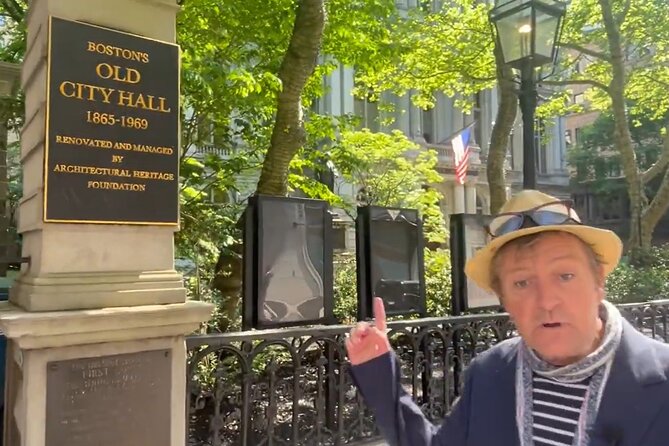
The tour moves to Boston Latin School, connected to School Street as the site of the first public school in the United States. You’ll also pass by King’s Chapel, Old City Hall, and the Parker House along the way.
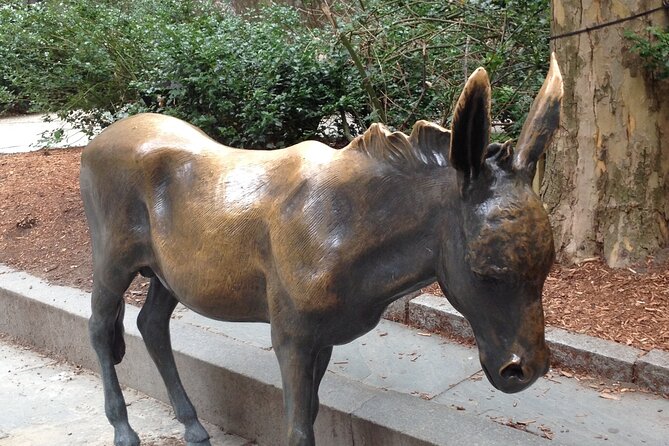
One small detail included here is Boston’s beloved donkey waiting patiently on School Street. It’s the kind of charming moment that keeps a history tour from feeling too heavy.
Why this stop matters: education is a foundational theme in civic life. When you understand that Boston had public schooling roots early, it changes how you interpret later political and religious conflicts.
Faneuil Hall Marketplace: the Cradle of Liberty and a weathervane detail that sticks
Faneuil Hall Marketplace is where the Revolutionary nickname shows up in real stone. The tour calls it the Cradle of Liberty and explains the grasshopper weathervane above, believed to be modeled after London’s Royal Exchange.
You’ll also learn about Peter Faneuil, gifted Boston’s hall and described here as a slave trader, and how the space became a meeting place for revolutionary leaders. The tour then connects Faneuil Hall to the Ancient and Honorable Artillery Company of Massachusetts, described as the oldest military body in the Western Hemisphere with a charter from 1837.
This stop gives you a lesson you can carry into the rest of your trip: Boston’s legacy is complicated. You get the democracy symbolism, and you also learn the uncomfortable economic roots behind the institutions.
Photo note: Faneuil Hall is an easy win for pictures, especially if you catch a moment when the street traffic pauses.
Ending at Boston City Hall: James Michael Curley and a practical last stretch
The tour ends in the shadow of Boston City Hall, beside two statues of James Michael Curley, described as a four-time mayor of the city, governor of Massachusetts, and congressman, and noted as a flamboyant big-city boss who dominated local politics for fifty years.
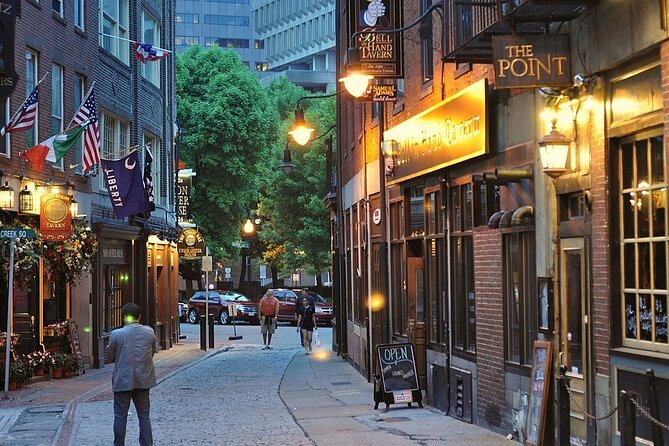
The tour position matters because it finishes you near places you’ll likely want to explore next. The guide area ends near Union Oyster House and the Bell in Hand tavern, with Hanover Street as the gateway toward the North End.
Good move after the tour: if your legs still work, wander toward the North End for an early meal or dessert. You’ll be walking through a neighborhood that feels like a continuation of Boston’s long layers of identity.
How the guide and group pace can affect your experience
This tour is designed for interaction, not lecture-only. The tour format explicitly gives you chances to ask questions, and many people highlight that the guide tells stories with specific details and names, not just general impressions.
The standout guide mentioned in the provided information is Stephen. Several comments point out his energy and detailed storytelling, and one notes he has used a voice amplifier microphone to help with hearing in Boston’s street noise. That’s a real practical detail for you, because the city can be loud and competing tour groups are common.
Still, there are a few cautions you should take seriously:
- The tour can feel fast-paced, especially if you stop asking questions and try to read every line yourself.
- Some people found the guide long-winded in certain stretches, or felt the tour ran over the expected schedule.
- If you’re traveling with small kids or you need quiet breaks, you might want to plan for a shorter attention window on your side.
If you like history explained like a story, you’ll probably enjoy it a lot. If you prefer a slow, plaque-by-plaque experience, plan on doing a little self-guided follow-up.
Who should book this tour, and who might prefer something else
Book this tour if you want:
- A short route that hits the core of Boston’s American Revolution story, plus Civil War and immigrant themes
- A guide who answers questions and connects people, places, and events
- A small-group walking format with easy-to-access stops
You might skip it if:
- You need lots of seated time or a slower pace
- You struggle with hearing in noisy outdoor spaces
- You want a mostly chronological, text-on-a-wall type tour rather than story driven explanations
Should you book this 2-hour Boston Historical and Heritage Walking Tour?
For $5, this is a very workable deal in the city center: you cover key landmarks, get strong context, and you can steer the conversation with questions. The best reason to book is simple, you leave with more than “what things are,” you leave with “why people acted the way they did.”
If you dress right for the weather, and you mentally commit to listening for spoken details, you’ll likely feel like the time flew by. If you need silence, slower stops, or lots of unhurried photo time, you may find the pace a little demanding.
If you’re here for a first taste of Boston and want street-level history you can carry into the rest of your day, this is an easy yes.
FAQ
How much does the Boston Historical and Heritage Walking Tour cost?
The price is $5.00 per person.
How long is the tour?
The tour is about 2 hours.
What time does it start?
It starts at 11:00 am.
Where do I meet the guide?
Meet at the Boston Common Tablet, 1634 Freedom Trl, Boston, MA 02108.
Where does the tour end?
The tour ends at the James Michael Curley Statues on Congress St at North St, Boston, MA 02108, across from Faneuil Hall.
Is the tour offered in English?
Yes, the tour is offered in English.
Is there a mobile ticket?
Yes, it uses a mobile ticket.
How large is the group?
The tour has a maximum of 24 travelers.
What if the weather is poor?
This experience requires good weather. If it is canceled due to poor weather, you will be offered a different date or a full refund.
Are service animals allowed?
Yes, service animals are allowed.
Written up lately around the harbor
- Boston’s Beacon Hill: Private Walking Tour
★ 5.0 · 1 review - Boston’s Chinatown: Small Group Walking Tour
★ 5.0 · 1 review - Self-Guided Scavenger Hunt: Boston Back Bay & Beyond
★ 4.0 · 1 review - Flynn Cruise Port Boston to Boston hotels – Arrival Private Transfer
★ 5.0 · 1 review - Boston to Woods Hole & Martha’s Vineyard Ferry Private Chauffeur Service
★ 4.0 · 1 review - Classic Martha’s Vineyard 1-Day Escape from Boston
★ 5.0 · 1 review - Private Vacation Photoshoot with Photographer in Boston
★ 5.0 · 1 review
Historical Tours, compared.
History and Hauntings of Salem Guided Walking Tour
Read our review →
Freedom Trail History Small Group Walking Tour
Read our review →
Tour of Historic Fenway Park, America’s Most Beloved Ballpark
Read our review →
Boston Food & History: Pizza, North End & Freedom Trail
Read our review →
Freedom Trail History Small Group Walking Tour
Read our review →
City Cruises Boston Historic Sightseeing Harbor Cruise
Read our review →
Boston’s North End Food Tour: Italian Flavors & Heritage Walk
Read our review →Browse the lists this tour appears in