
Reviewed · SALEM WITCH TRIALS TOURS
Salem Witch Tour
Salem turns eerie history into a walking timeline. This Salem Witch Tour links landmark stops in 1-to-2 hours, with a mobile ticket and a guide who keeps the pace human and easy to follow. You will see the memorial, the cemeteries, key trial connections, and even a pop-culture photo stop tied to Bewitched.
I love the big value of free admissions at most stops, plus the way the story connects people, places, and dates. I also like the small group size (max 10), which makes it simpler to ask questions, take photos, and pause when you need a quick breather.
One possible drawback: the Witch House has admission that is not included, so you may want to plan a little extra time and budget if you want to go inside.
In This Review
- Key things to know before you go
- Where the tour starts at Peabody Essex Museum and how it fits your day
- PICKMAN House first: why the pre-memorial storytelling matters
- Salem Witch Trials Memorial: granite walls, protests of innocence, and execution dates
- Old Burying Point Cemetery (Charter Street Cemetery) and why 1637 changes the context
- Old Town Hall on the brick streets: civic life beyond the accusations
- The Bewitched statue: Samantha Stephens, a crescent moon, and a Salem TV connection
- The Witch House at Salem: Jonathan Corwin and the one building still standing
- Turner’s Seafood at Lyceum Hall: Bridget Bishop’s property and the Salem jail site
- Roger Conant Statue: a closing beat for Salem’s timeline
- Bilingual guiding, small-group pacing, and optional tarot reading value
- Who this Salem Witch Tour suits best
- Should you book this tour?
- FAQ
- How long is the Salem Witch Tour?
- Where does the tour start and where does it end?
- What languages is the tour offered in?
- Is admission included for the Witch House?
- Are there stops with free admission?
- Is coffee or tea included?
- How much does tarot or palm reading cost?
- Is the tour cancellable for free?
Key things to know before you go
- Start at Peabody Essex Museum and end back where you begin, so you can stay oriented downtown.
- PICKMAN House stories first, so the memorial feels personal instead of like a textbook.
- Salem Witch Trials Memorial has a handwritten-feel stone design, with protests of innocence and benches listing names and execution dates.
- Old Burying Point Cemetery dates to 1637, one of the oldest maintained cemeteries in the US.
- Bewitched Statue of Elizabeth Montgomery is a real photo magnet, and Salem filmed episodes there in 1970.
- Optional tarot or palm reading costs extra (listed as $40 for 15 minutes), separate from the main tour.
Where the tour starts at Peabody Essex Museum and how it fits your day
The tour begins at Peabody Essex Museum, 161 Essex St, Salem, MA 01970. That is a smart starting point because it is a central landmark, and the tour ends back at the same meeting area. If you are thinking about food or parking after, this “loop back” style helps.
Time-wise, plan on about 1 to 2 hours. This is not a long endurance march, and the tour cadence includes multiple short stops that keep things manageable. The physical requirement is listed as moderate fitness, so comfortable shoes matter, but you are not doing a forced hike.
Group size is capped at 10, which changes the vibe. With fewer people, the guide can actually check in, keep directions clear, and handle questions without the whole group feeling rushed. Also, service animals are allowed, and the route is near public transportation, so you have options if you do not want to rely on a car.
More on the witch trials and where they happened:
- The Salem Witch Walk★ 4.5 · 1,301 reviews
- Wicked Awesome Tours: Witch Trial History and Salem Haunts!★ 5.0 · 1,032 reviews
- Best Salem Witch Trials Historical Walking Tour★ 4.0 · 743 reviews
PICKMAN House first: why the pre-memorial storytelling matters
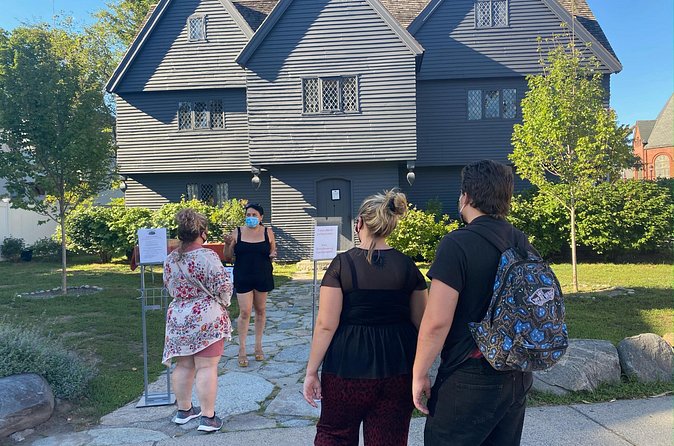
Before you even reach the memorial, the tour starts with the PICKMAN HOUSE, one of Salem’s oldest houses. This first stop sets the tone. Instead of jumping straight into names and dates, you get background that helps you understand why these buildings and streets mattered to real people.
The key benefit here is pacing. When you arrive at the Witch Trials Memorial, you are not just absorbing tragedy. You are stepping into a larger Salem story, where ordinary homes and civic life sit next to extraordinary fear and accusation.
Then you move on to the memorial itself with time built in. The Witch Trials Memorial stop is set for about 15 minutes, and the admission there is free. For a short walking tour, that is a meaningful window. It gives you time to read what is there instead of sprinting past.
If you are visiting with kids, this sequence can also help. You get a calmer opening with “where are we and why does this matter,” before things turn heavy.
Salem Witch Trials Memorial: granite walls, protests of innocence, and execution dates
This memorial is designed to slow you down. It sits inside a handcrafted granite wall that surrounds the space on three sides, which helps create a quiet pocket even while you are still in a public area.
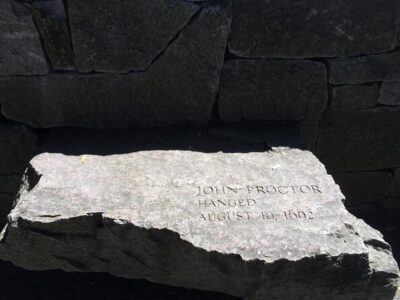
As you enter, there are inscriptions in the stone threshold that record victims’ protests of innocence. That detail matters because it flips the script from accusation to denial. You are reminded that these were not people admitting guilt. They were people insisting they were innocent.
Inside, benches within the memorial perimeter bear names and execution dates of each of the 20 victims. That is the kind of information that can hit hard, but it is also what makes the site educational in a grounded way. You can walk around, pause at specific names, and understand that this was not one event, it was a series of executions tied to dates.
The memorial is listed as appropriate for all ages, which I interpret as: you can bring families, but you should be ready for emotional subject matter. If your group prefers lighter topics, this stop is the most intense moment on the route.
Old Burying Point Cemetery (Charter Street Cemetery) and why 1637 changes the context
Next you head to Old Burying Point Cemetery, also known as the Charter Street Cemetery. This is the oldest maintained cemetery in Salem and among the oldest in the United States. It opened in 1637, so it anchors Salem’s story in a much longer timeline than the witch trials alone.
The tour frames this as a quick stop, around 5 minutes, and admission is free. That short timing means you will not read every stone, but it is long enough to grasp the place. When you see a cemetery that old, the witch trials feel less like a standalone “dark chapter” and more like something that erupted inside an already established community.
It is also a nice mental reset after the intensity of the memorial. A cemetery can be reflective without being sensational, and it helps you balance the story. You get to think about continuity, families, and how Salem changed over generations.
Old Town Hall on the brick streets: civic life beyond the accusations
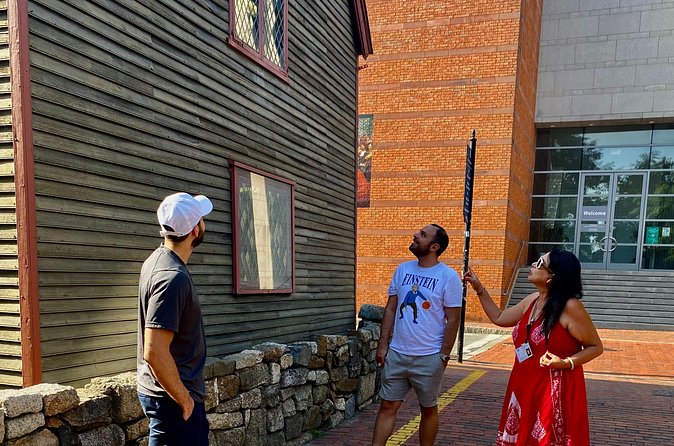
Salem’s Old Town Hall is a Federal style building erected in 1816. It is the namesake of the Old Town Hall National Historic District. Today, it is no longer used for municipal operations. Instead, it functions as a cultural and rental facility in service to the community of Salem.
The building itself makes the “civic” point visually. You will see the two-story brick structure, Palladian windows, carved wood details, antique chandandeliers, decorative columns, and hardwood floors. Even if you only spend about 5 minutes here, it is a strong contrast to the witch trial sites.
Why this stop is valuable: it reminds you that Salem was not only courts and accusations. It had institutions, architecture, and community functions that continued before and after the trials.
If you prefer architecture, this is one of the easiest wins on the tour. You get strong exterior and interior-feel details quickly, without needing a separate museum ticket.
More time up in Salem:


The Bewitched statue: Samantha Stephens, a crescent moon, and a Salem TV connection
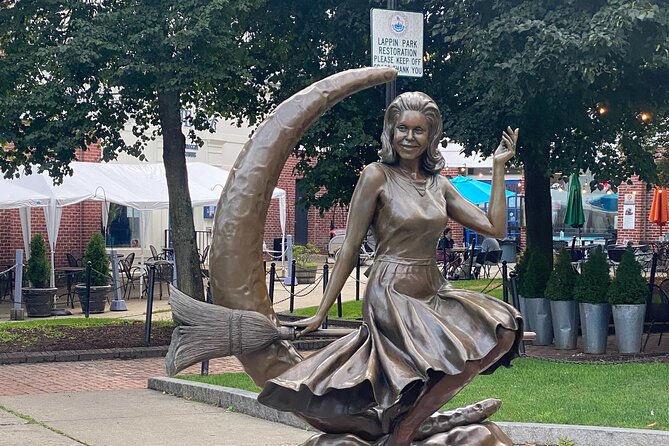
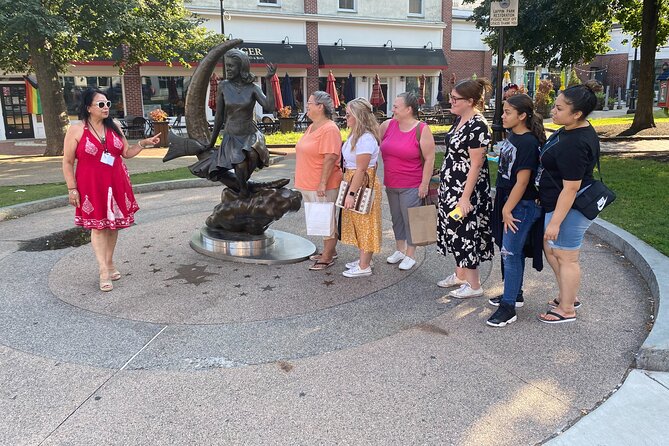
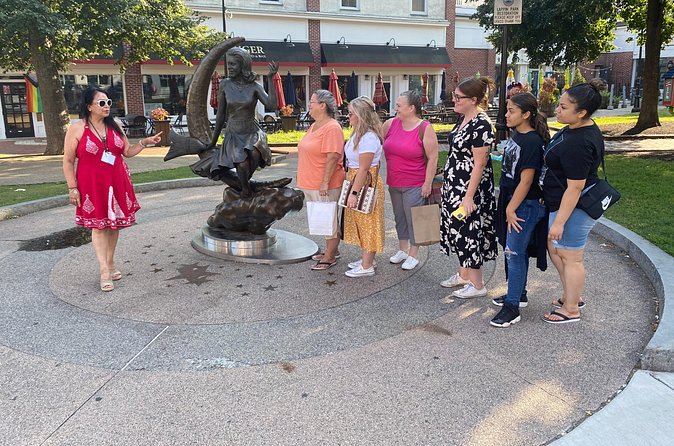
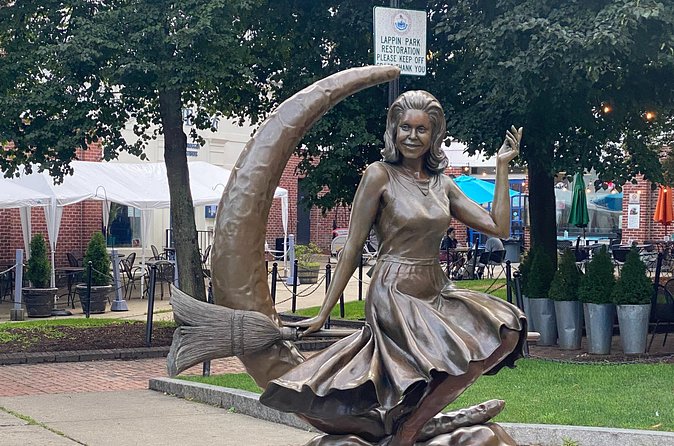
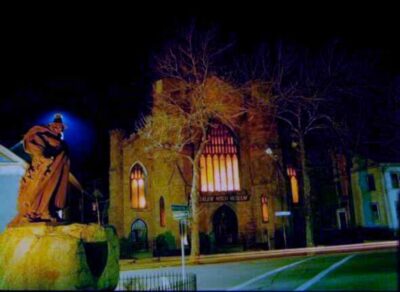
One of the most fun stops is the Bewitched Statue of Elizabeth Montgomery. Measuring six feet tall, the bronze statue depicts Samantha Stephens sitting sidesaddle on a broom next to a crescent moon.
The city’s connection to pop culture matters here. Several episodes of Bewitched were filmed in Salem in 1970, and Salem has embraced that link. So this is not random trivia. It is part of how Salem tells its own story today, mixing tragedy with tourism and entertainment.
Time for pictures is built in, about 10 minutes, and admission is free. This is a good moment to slow down, get your photos, and regroup with your group before the tour turns more trial-focused again.
Practical tip: if you care about photo quality, arrive ready. Bring your phone battery, wipe off your lens, and try a second angle. The statue’s pose is very photo-friendly from a few directions.
The Witch House at Salem: Jonathan Corwin and the one building still standing
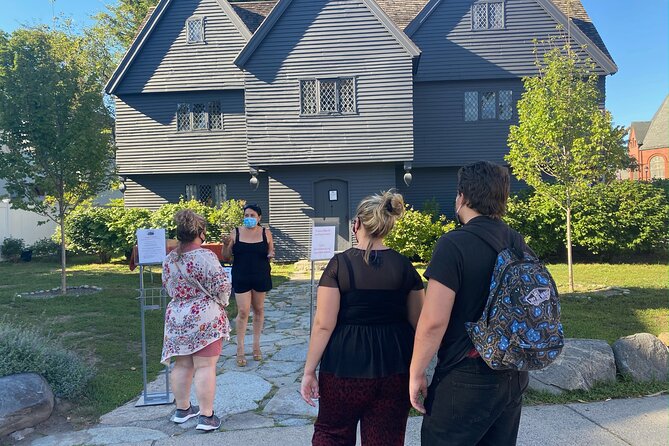
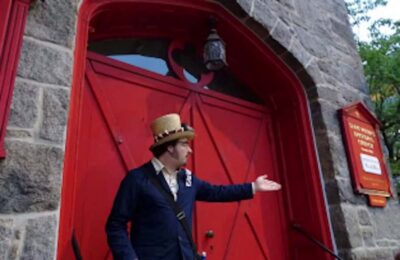
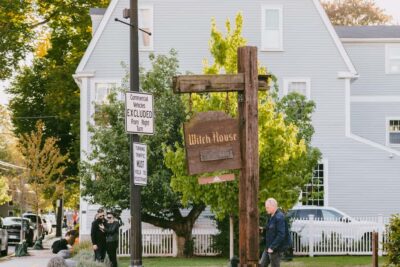
The Witch House is the tour’s most important historical stop for trial connections, and it is also the one place where the admission is not included.
This house was home to Jonathan Corwin (1640 to 1718), uncle of High Sheriff George Corwin. The Witch House is described as the only extant building with direct ties to the Salem Witch Trials. That matters because it is not just a “nearby era building.” It is tied to a specific person connected to the court.
Jonathan Corwin served on the court of Oyer and Terminer that convicted the witches. The house also connects to Roger Williams, who also lived there before founding Providence Plantation in Rhode Island.
Then there is the physical history of the structure itself. The house was moved about 11 meters from its past location in the 1940s to accommodate road widening. That is a detail you would not get from a typical “quick look” stop, and it helps you understand how Salem has changed around the surviving landmarks.
You have about 10 minutes here on the tour. If you want to go inside, you should plan for the extra admission. The tradeoff is worth it if you like primary-location history, because this is the one stop where the building is tied directly to the trial system through named individuals.
Turner’s Seafood at Lyceum Hall: Bridget Bishop’s property and the Salem jail site
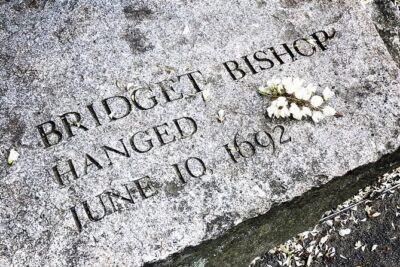
The tour then shifts to a location connected to Bridget Bishop. The information provided states that this was the property of Bridget Bishop (around 1632 to June 10, 1692), who was the first person executed for witchcraft during the Salem witch trials in 1692.
Seeing a trial figure tied to a real property helps the story feel grounded. It is not only courts and accusations. It is also how fear turned into enforcement, how a person’s life became a public event, and how the “where” mattered.
After that, the tour continues to the site of the infamous Salem Jail. This is where people were arrested for allegedly practicing witchcraft and imprisoned before being hanged.
That pairing is powerful for your understanding. The Bridget Bishop property connection points to the start of a case story, then the jail site makes clear what came next. The stop time here is about 15 minutes and admission is free.
If you want to get the most out of this segment, take a moment to imagine how the route would have felt. You are walking the same general urban geography that turned private lives into public punishments.
Roger Conant Statue: a closing beat for Salem’s timeline
The last major stop is the Roger Conant Statue, with about 5 minutes allocated and admission free. Roger Conant is often associated with Salem’s earlier leadership, and ending here gives the tour a subtle reset.
Even without a long stop, the effect is useful. You are not only leaving with the witch trial chapter stuck in your head. You are also reminded that Salem’s story includes earlier settlement roots and later echoes.
Then the tour wraps up back at Peabody Essex Museum. That keeps your logistics simple, especially if you want to grab lunch, browse the museum, or continue walking downtown on your own.
Bilingual guiding, small-group pacing, and optional tarot reading value
The tour is offered in English, Spanish, French, and Italian. That matters because it gives you a way to get the story in a language you can actually process while walking. And it is not just translation, it is the overall pacing and tone that help the information land.
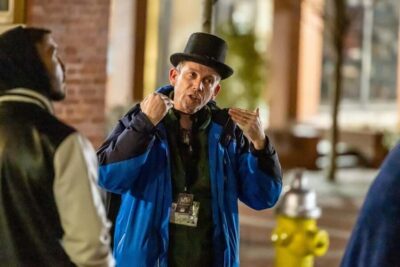
From the guidance style described, Cynthia is a highlight for many people. She is described as very helpful and friendly, and she shares a lot of information without making it feel like a lecture. One practical detail that shows up repeatedly is the stop frequency. The pace works even with small children, which is a big deal on a topic that can otherwise feel heavy.
You also get movement tips for Salem. That helps because Salem is full of small streets and frequent stops. A good guide makes the difference between feeling lost and feeling like you are building a mental map fast.
About the optional readings: tarot or palm reading is listed as not included, and the cost is $40 for 15 minutes. If you are curious, this can be a fun add-on. If you are here for history only, you can skip it. Either way, the main tour time is structured around the landmark stops.
Who this Salem Witch Tour suits best
This is a great fit if you want a focused walk through Salem’s best-known witch trial connections without spending half a day in museums. It is also a good choice for families who need a tour that breaks into short segments and does not keep one group stuck in one place too long.
You will also like it if you enjoy the contrast between serious history and Salem’s modern storytelling, like the Bewitched statue photo stop filmed in 1970. And because the group max is 10, it feels more personal than big-bus-style tours.
If you want deep museum-style interpretation, you might still want to add time elsewhere. The Witch House may require an extra admission, and there are also notes that museum entrances are not included. Think of this as a high-impact walking overview, then let your interests decide where to go next.
Should you book this tour?
Book it if you want an efficient, high-signal way to see key Salem witch trial sites, cemetery context, and one standout historic building tied directly to the trials. The value is strong because so many stops are free, and the small-group pacing keeps the experience readable and not exhausting.
Skip it, or plan your own add-ons, if you only want museum interiors or you know you would rather spend more time at the most emotionally intense memorial elements. Also consider whether the Witch House admission matters to you, since that part is not included.
If you come with comfortable shoes, a little curiosity, and respect for the subject matter, you will leave with a clearer picture of how Salem got from accusation to execution, and how the city remembers it today.
FAQ
How long is the Salem Witch Tour?
The tour runs about 1 to 2 hours.
Where does the tour start and where does it end?
It starts at Peabody Essex Museum, 161 Essex St, Salem, MA 01970, USA, and ends back at the same meeting point.
What languages is the tour offered in?
The tour is available in English, Spanish, French, and Italian.
Is admission included for the Witch House?
No, entrance to a museum is not included, and the Witch House stop lists admission as not included.
Are there stops with free admission?
Yes. The Salem Witch Trials Memorial, Old Burying Point Cemetery, Old Town Hall, the Bewitched Statue photo stop, Turner’s Seafood at Lyceum Hall area, and the Roger Conant Statue are listed as admission ticket free.
Is coffee or tea included?
No, coffee and or tea are not included.
How much does tarot or palm reading cost?
Tarot or palm reading is listed as $40 for 15 minutes.
Is the tour cancellable for free?
Yes, you can cancel for free up to 24 hours in advance for a full refund.
Written up lately around the harbor
- High Witch History Walking Tour of Salem
★ 5.0 · 1 review - Haunted Salem Ghost Tour
★ 2.0 · 1 review - Multilingual Self-Guided Audio Ghost Tour in Salem
★ 5.0 · 1 review - Salem Private Half Day Tour from Boston, groups 5-6
★ 5.0 · 1 review - From Boston: Salem & Hammond Castle Semiprivate Day Trip
★ 5.0 · 1 review - Family Friendly Ghostly Tales of Salem
★ 5.0 · 1 review - Tales of Salem Halloween Guided Walking Tour
★ 4.5 · 2 reviews
Salem Witch Trials Tours, compared.
Wicked Awesome Tours: Witch Trial History and Salem Haunts!
Read our review →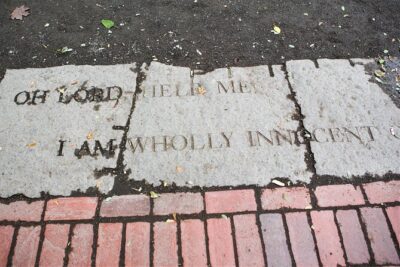
Best Salem Witch Trials Historical Walking Tour
Read our review →
Browse the lists this tour appears in