
Reviewed · AUDIO TOURS
Boston Civil War and Abolition Movement: A Self-Guided Audio Tour
A walk that teaches without a crowd. This Boston Civil War and Abolition Movement audio tour connects key abolition figures to real street corners, with offline access and lifetime playback in English.
Two things I really like: you can follow at your own pace, and the materials are built to work even when your signal drops.
One catch to plan for: it is self-guided, so you are not taken inside museums or ticketed exhibits mentioned along the way. If you want extra depth inside any buildings, you will need to pay for those separately.
In This Review
- Key highlights before you start
- A Self-Guided Boston abolition walk that fits your pace
- Price and time on foot: what $11.99 really buys
- Faneuil Hall to Old State House: Daniel Webster and the Union fight
- Old Corner Bookstore and Old South Meeting House: abolition spread through words
- Boston Irish Famine Memorial to Tremont Temple: two communities, one moral challenge
- Granary Burying Ground and Paul Revere’s Grave: old names, new meaning
- Robert Gould Shaw and the 54th: courage, respect, and Massachusetts in war
- Soldiers and Sailors Monument: closing the loop with Massachusetts commitment
- Who this audio tour is best for
- Should you book this Boston Civil War and Abolition Movement audio tour?
- FAQ
- How long does the Boston Civil War and Abolition Movement self-guided audio tour take?
- Where does the tour start and end?
- How much does it cost?
- What do I need to use the tour?
- Can I use the tour offline?
- Are museums or attractions included as part of the guided experience?
- Is the tour private?
- Is the experience refundable if I cancel?
Key highlights before you start

- Offline-ready audio and maps so you can keep walking without hunting for service
- Lifetime access to the tour in English, great value if you are visiting more than once
- 11 Civil War and abolition stops that keep the story moving from politics to people
- A humorous wrong-turn alert in the app if you wander off track
- All stops are listed as free to view while you walk by
- A clean start-to-finish route from Faneuil Hall Visitor Center to Soldiers and Sailors Monument
A Self-Guided Boston abolition walk that fits your pace

This kind of tour is ideal when you like history but hate the pressure of a group schedule. You press play, follow the route, and get short, focused audio segments at each stop. The big benefit is control. If you want to linger at Granary Burying Ground for the names and dates, you can. If your legs get tired, you can keep moving and finish strong.
The route is also designed around familiar Boston landmarks, which helps you orient fast. You start at Faneuil Hall and end at the Soldiers and Sailors Monument, so the walk has a clear arc. You are not guessing what to do next. The app cues you at each place, and the offline maps and geodata help you stay oriented.
Finally, I appreciate the practical tone of the experience. Even the app nudges you with a playful message if you go the wrong direction, All who wander are not lost, but you may want to check your directions. It is small, but it makes the experience feel human and easy to troubleshoot.
A few other harbor-city days to consider
- Self Guided Classic Freedom Trail Location Aware (GPS) Walking Audio Tour★ 4.5 · 258 reviews
- Boston Freedom Trail Self-Guided Tour with Audio Narration & Map★ 4.5 · 98 reviews
- Self-Guided Boston’s Beacon Hill Underground Railroad Audio Tour Walking Tour★ 4.5 · 29 reviews
Price and time on foot: what $11.99 really buys
At $11.99 per person, this is a low-risk way to add a lot of context to a walking afternoon. The duration runs about 1 hour 30 minutes to 2 hours, which is long enough to connect the story threads, but short enough to fit alongside other Boston plans.
What you get for that price is not a guided lecture inside buildings. It is an audio story timed to the street. That matters. You are buying a route and commentary, plus voice and map support through the VoiceMap app. You also get lifetime access, which is a real advantage if you want to revisit later, or if you want to replay parts when you are studying.
What to budget besides the tour cost:
- Smartphone and headphones are not included, so bring your own
- Food and drink are not included
- There is no transportation included, so plan to arrive on foot, subway, or bus
And one more planning note that can save you time: the tour does not guide you through museums or paid attractions. You will walk past and listen, but if you choose to go inside something you see, you will pay for that separately.
Faneuil Hall to Old State House: Daniel Webster and the Union fight
Your tour begins in front of the Faneuil Hall Visitor Center at Faneuil Hall Marketplace. This is a smart starting point. Faneuil Hall is the kind of place where Boston political life has echoed for centuries, so it sets the stage immediately.
At Stop 1, the focus is on Daniel Webster and his long effort, described here as 30 years, to save the Union. Even if you only know Webster as a name from school, the audio angle helps you place him in the Civil War era story. You are not just hearing about battles. You are hearing about decisions, arguments, and staying power in national politics.
Stop 2 is the Old State House, and the route uses the buildings like a textbook. You will pass several examples of Georgian architecture connected to Boston’s civic life, including the Old Court House, New State House, and Old City Hall. The audio is built around the idea that architecture can act like evidence. These are not neutral backdrops. They frame where power sat and where public messages landed.
One thing to consider at these first stops: because you are walking outdoors, weather matters. Boston can change quickly, so if you are going in cooler months, dress for the wind and keep a light layer handy.
Old Corner Bookstore and Old South Meeting House: abolition spread through words
Stop 3 takes you outside the Old Corner Bookstore. This is where the tour ties abolition to publishing, and it does so with a specific, memorable story: Harriet Beecher Stowe and why she traveled from Ohio to Boston to publish Uncle Tom’s Cabin. The point here is important. The anti-slavery movement was not only meetings and speeches. It was also print, persuasion, and reaching people who might never meet someone affected by slavery.
If you enjoy understanding how ideas move, you will like this portion. Boston mattered because it had the printing and distribution channels to amplify shock and empathy.
Stop 4 is the Old South Meeting House. You will not be led inside, but you will hear the building’s significance as you walk. The value is that the audio keeps you from treating the site like a postcard. You get a historical lens while your feet keep moving.
Potential drawback for some people: if you love museum-style interpretation, you might wish the tour offered interior access here. But that is also why the tour stays affordable and time-efficient. You get the essential context without paying for an extra ticket just to stand and listen longer.
Boston Irish Famine Memorial to Tremont Temple: two communities, one moral challenge
Stop 5 is the Boston Irish Famine Memorial, along with other nearby monuments. This stop broadens the Civil War and abolition story into the immigrant experience. You will hear history about the Irish in Boston and how memory is shaped in public space.
This is a good moment to slow your thinking down. The abolition movement was shaped by many communities, not only those that fit neatly into one textbook narrative. The audio here gives you a reminder to watch how one era’s hardship echoes into the next.
Stop 6 is outside Tremont Temple Baptist Church, where the story centers on Frederick Douglass. The tour notes that Douglass once spoke to a mostly white congregation on the 4th of July, and he challenged the idea that it was a celebration of freedom for people who had lived through slavery. That detail hits hard, in a useful way. It reframes American holidays as moral arguments, not just patriotic traditions.
If you are sensitive to powerful topics, you will probably appreciate how the tour handles this: it uses a specific event and a clear message. You are not left with vague themes.
Another way the same afternoon could go around Boston:




Granary Burying Ground and Paul Revere’s Grave: old names, new meaning

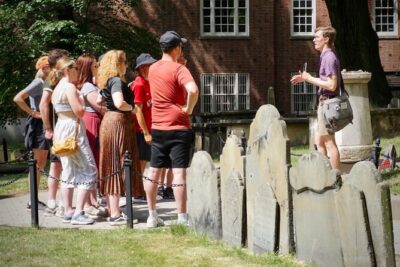
Stop 7 is Granary Burying Ground, where you will wander and see the graves of John Hancock and Paul Revere. This part works because it slows you down just enough. You are getting names you already recognize, but the audio can help you connect them to the larger American story that leads into the Civil War.
Stop 8 goes specifically to Paul Revere’s grave. Here, the audio steps back about 300 years of history and explains Revere’s role in the American Revolution. The clever move is that the tour does not treat the Civil War era as isolated. It keeps reminding you that the national ideals people fought over in 1770s streets were still being argued over in the 1860s.
A practical tip: this is one of the easiest spots to get pulled into taking photos and reading stone inscriptions. If you do, just keep an eye on your time so you do not rush the later stops.
Robert Gould Shaw and the 54th: courage, respect, and Massachusetts in war

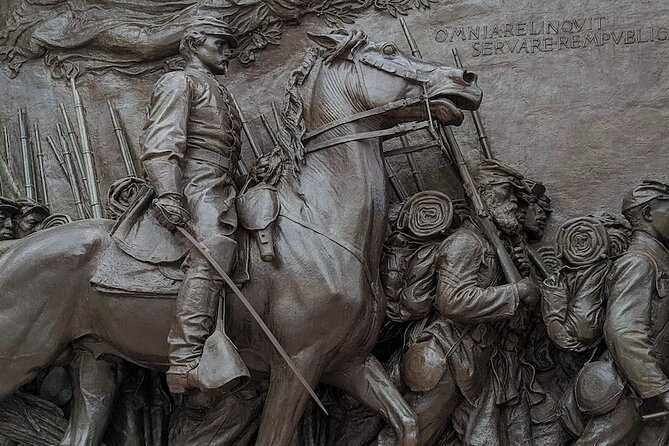
Stop 9 is the Robert Gould Shaw and the 54th Regiment Memorial. This is one of the strongest places on the route because the audio zeroes in on the human cost and the struggle for recognition. You will hear about the 54th Colored Regiment, and it frames their fight as part of gaining respect and helping create the conditions for 180,000 additional recruits during the Civil War.
If you want the abolition movement to feel real, this is where it does. Not by drowning you in facts, but by linking one memorial to a broader recruitment and political shift. You walk away understanding that dignity and agency were fought for, not granted.
Then Stop 10 is Louisburg Square. Here the audio follows the end of Louisa May Alcott’s life and points out that it was once the most expensive real estate in Boston while you walk through the square. This choice may surprise you. Why does a children’s literature icon show up near a Civil War memorial route? The answer, built into the audio structure, is that Boston’s social world, its money, and its writers all orbit the same historical era. You get a reminder that the Civil War era shaped the city far beyond battlefields.
The main consideration in this section: by now, you have been walking for a while. Wear shoes that do not punish you on stone sidewalks and curbs. It is a short route, but it still adds up in 90 to 120 minutes.
Soldiers and Sailors Monument: closing the loop with Massachusetts commitment

Your tour ends at the Soldiers and Sailors Monument at 139 Tremont St. This wrap-up is dedicated to the 120 regiments from Massachusetts that fought in the Civil War.
Ending here makes sense because it gives your walk a “so what” moment. Up to this point, you have moved through individuals, ideas, and institutions. Now you get a statewide scale.
If you want to keep the story going after the tour, this is a good place to pause and look up the names, symbols, and inscriptions. Even if you do not read everything, taking 5 minutes to absorb the monument helps the rest of the route land in your head.
Who this audio tour is best for
You will probably love this if you:
- Want a low-cost way to learn Boston’s Civil War and abolition connections
- Prefer short stops and a self-paced route over sitting through a long guided talk
- Enjoy the link between people and places, like Webster, Stowe, Douglass, Shaw, and Alcott
- Like a modern tool, especially offline maps and audio through the VoiceMap app
It may be less ideal if you:
- Want an in-depth museum experience inside buildings, because the tour focuses on walking and listening
- Expect a tour guide on site to answer questions, because this is audio-led and self-managed
Should you book this Boston Civil War and Abolition Movement audio tour?
I think this is a smart booking if you want a focused, affordable way to turn a walk through Boston into a real story. The biggest value is how many major names and themes you touch in about 2 hours, without paying for extra tickets. Lifetime access also makes it easier to justify, since you can reuse it on another trip.
Book it if you want practical, on-the-ground storytelling from Faneuil Hall to the Soldiers and Sailors Monument, with offline support and a friendly app experience. Skip it only if you specifically want guided interior museum access. Otherwise, this route is exactly the kind of self-guided history that makes Boston feel personal and immediate.
FAQ
How long does the Boston Civil War and Abolition Movement self-guided audio tour take?
It takes about 1 hour 30 minutes to 2 hours.
Where does the tour start and end?
It starts at the Faneuil Hall Visitor Center, 1 Faneuil Hall Sq, Boston, MA 02109, and ends in front of the Soldiers and Sailors Monument, 139 Tremont St, Boston, MA 02109.
How much does it cost?
The price is $11.99 per person.
What do I need to use the tour?
You need to bring a smartphone and headphones. The VoiceMap app is used for the tour, and it includes offline access to audio, maps, and geodata.
Can I use the tour offline?
Yes. The tour includes offline access to audio, maps, and geodata.
Are museums or attractions included as part of the guided experience?
No. You are not guided through museums or other attractions mentioned along the route. If you choose to enter places you pass, you pay for those separately.
Is the tour private?
Yes. It is a private activity, and only your group will participate.
Is the experience refundable if I cancel?
No. The experience is non-refundable and cannot be changed for any reason.
Written up lately around the harbor
- Boston’s Beacon Hill: Private Walking Tour
★ 5.0 · 1 review - Boston’s Chinatown: Small Group Walking Tour
★ 5.0 · 1 review - Self-Guided Scavenger Hunt: Boston Back Bay & Beyond
★ 4.0 · 1 review - Flynn Cruise Port Boston to Boston hotels – Arrival Private Transfer
★ 5.0 · 1 review - Boston to Woods Hole & Martha’s Vineyard Ferry Private Chauffeur Service
★ 4.0 · 1 review - Classic Martha’s Vineyard 1-Day Escape from Boston
★ 5.0 · 1 review - Private Vacation Photoshoot with Photographer in Boston
★ 5.0 · 1 review
Audio Tours, compared.

Self Guided Classic Freedom Trail Location Aware (GPS) Walking Audio Tour
Read our review →
Boston Freedom Trail Self-Guided Tour with Audio Narration & Map
Read our review →
Self-Guided Boston’s Beacon Hill Underground Railroad Audio Tour Walking Tour
Read our review →
Self Guided “Historic Boston Downtown Freedom Trail” Audio/GPS Walking Tour
Read our review →
Boston’s Old North Church Admission with Self-Guided Audio Tour
Read our review →
Boston’s Freedom Trail: A Self-Guided Audio Tour
Read our review →
Boston Harborwalk & Tea Party Self-Guided Walking Audio Tour
Read our review →
City History and Highlights Audio App Walking Tour
Read our review →Browse the lists this tour appears in