
Reviewed · FREEDOM TRAIL TOURS
Boston’s Freedom Trail: A Self-Guided Tour of All 16 Sites
You can hear Boston’s founding story without chasing a group. This self-guided Freedom Trail tour strings together the big moments, from public meetings to the Tea Party, with audio that plays as you go. The best part is that you control the pace, so you can linger where the streets feel personal and skip ahead when you are ready.
I love the offline audio and maps setup, because you are not hunting for service between stops. I also love that the narration is clear and story-driven, with humor and momentum that make the 16 stops feel connected instead of like a checklist.
One thing to consider, you will need your own smartphone and headphones. If your phone battery runs low, you will want a plan, like a power bank, so the audio and map do not drop out.
In This Review
- Key highlights worth planning around
- Why this Freedom Trail tour feels good on foot
- Price and timing, how $14.99 fits real travel days
- Where you start at 139 Tremont St, and how the app pacing works
- Faneuil Hall: where public debate still feels close
- The Revolution storyline: the Tea Party, Revere, and the city under tension
- Brewer Fountain and the Massachusetts State House: civic Boston in gold and brick
- Gravestones that name the makers: Otis, Hancock, Revere, Adams
- Old City Hall and the 1713 building: power, law, and trade
- Old South Meeting House and the practical breaks you will want
- The Irish immigrant chapter and the Boston Massacre scene
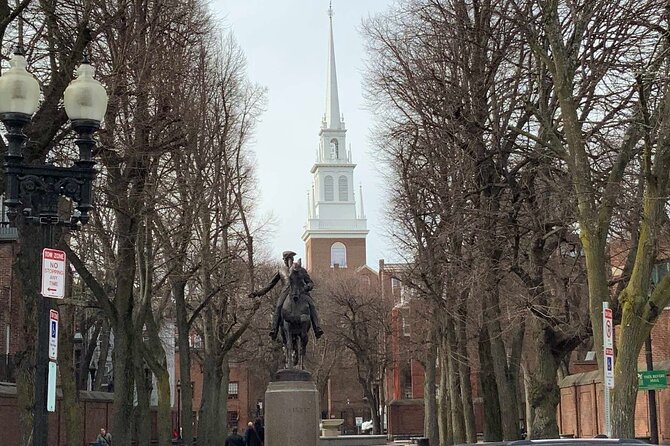
- The outdoor market finish and Copp’s Hill views toward USS Constitution and Bunker Hill
- Practical tips so you do not get lost or stuck on tech
- Should you book this self-guided Freedom Trail tour?
- FAQ
- How long does the Freedom Trail self-guided tour take?
- What is the price per person?
- Can I use it offline?
- Does the tour include museum tickets or entrance fees?
- Do I need my own smartphone and headphones?
- Where does the tour start and where does it end?
- Is this tour refundable if I cancel?
Key highlights worth planning around
- Offline-ready VoiceMap audio, maps, and geodata for spotty cell coverage days
- 16 Freedom Trail sites linked into one continuous walking story
- All your pace options: pause, take breaks, and restart when you want
- Narration by James with a confident, humorous style many listeners praised
- Finish at Copp’s Hill Terrace, with views toward USS Constitution and Bunker Hill
Why this Freedom Trail tour feels good on foot
Boston’s Freedom Trail is famous for a reason, but doing it the traditional way can feel like constant motion. This audio-first version lets you slow down for street corners, plaques, and churchyards, then move quickly when you want to keep the energy up. I like that it is not just facts, it is the sense of how ordinary people and city officials kept making choices that shaped the country.
You will walk through places tied to public debate, rebellion, and everyday life. You also get the important darker notes, including the Boston Massacre scene and the Irish immigrant story tied to a biological tragedy in Ireland. That balance matters. It makes the route feel like real Boston, not a stage set where everyone speaks in speeches.
And since it is private for your group, you do not have strangers crowding your comfort level while you listen. It is built for walking, stopping, and listening without the pressure of a guide herding a group.
More ways along the Freedom Trail:
- Boston: Freedom Trail History Small Group Walking Tour★ 5.0 · 6,450 reviews
- Boston Freedom Trail Walking Tour with Costumed Guide★ 4.5 · 2,531 reviews
- Boston Food & History: Pizza, North End & Freedom Trail★ 5.0 · 1,772 reviews
Price and timing, how $14.99 fits real travel days
At $14.99 per person, this is one of the cheaper ways to get a guided-style experience without booking a formal group tour. The value comes less from the walking itself and more from what you receive with it: lifetime access to the English audio and offline content.
In practice, the timing is workable. The tour runs about 2 hours to 2 hours 40 minutes, and one clear datapoint from actual use is that it can land around 2.5 hours if you listen closely. That puts it in the sweet spot for a half-day plan. You can fit it between meals, or do it in late morning when you want daylight for outdoor stops.
Booking tends to be done ahead of time, and that is a good sign for a popular route. Still, even if you are planning last minute, this format is flexible. You are not dependent on a specific tour departure time once you have downloaded the app content and are ready to walk.
If you are traveling solo, couples, or just the kind of traveler who likes to stop for a photo without asking permission, this price makes sense because you are buying convenience and narrative, not a seat on a bus.
Where you start at 139 Tremont St, and how the app pacing works
You begin at 139 Tremont St, Boston, MA 02111, and you finish at Copp’s Hill Terrace, 520 Commercial St, Boston, MA 02109. The route is designed to be used as you walk, with offline access to audio, maps, and geodata included.
Most of the time, the whole point is friction-free listening. One person loved that the audio would automatically start when reaching the next location. Another person said the map did not always read their exact spot, and they sometimes had to manually press forward or replay if a story paused mid-way.
My advice: treat your first 5 minutes as a warm-up. Stand near the starting point, launch the audio, and confirm you can hear clearly. Then, when the map arrow feels uncertain, do not panic. Just use the forward controls and trust the narration to bring you to the next stop.
Also, remember this does not include a phone or headphones. Bring a comfortable headset, and if your battery life is questionable, charge before you head out. You are walking for a couple hours, so a fully charged phone matters more than you think.
Faneuil Hall: where public debate still feels close
The first real anchor on your walk is Faneuil Hall. You start by stepping into a place that used to host town meetings where Samuel Adams spoke, and today functions as a government auditorium. That mix is part of the magic here. You are in a room where civic life is the main character.
What you gain from having audio for this stop is context. A site like Faneuil Hall is easy to see and easy to misunderstand if you just read a plaque. The narration helps you connect it to the role of public meetings in building pressure for independence.
The other nice bonus is practical. This is a good early landmark to orient yourself. If you need to catch your breath, adjust your camera, or figure out the rest of your walking pace, it is an easy place to pause before the story accelerates.
If you are sensitive to crowds, you might pick a calmer time of day. Still, because you are self-guided, you control how long you linger.
The Revolution storyline: the Tea Party, Revere, and the city under tension
The heart of the Freedom Trail walk is the tightening story of rebellion. In this tour, the narrative explicitly threads three big pieces: the Paul Revere moment, the Boston Tea Party, and the lead-up to open conflict.
You will hear how colonists gathered to throw 92 tons of tea into Boston Harbor. It is the kind of fact that sounds wild until you place it in the streets and docks you can actually walk. The audio framing makes it feel less like a legend and more like a coordinated political act by regular people.
You also get the Midnight Ride story. You learn about Revere leaving on his ride before getting arrested. That detail matters, because it reminds you that hero narratives can include mess, risk, and consequences.
One more layer that the audio brings is the way multiple turning points feed each other. It does not treat the Tea Party and the Midnight Ride as separate events. It shows you how momentum builds, and then how quickly things shift once violence and fear enter the picture.
If you like a clear story arc, this is one of the biggest strengths of the format. You are not just moving between monuments. You are moving between chapters.
A few other harbor-city days to consider




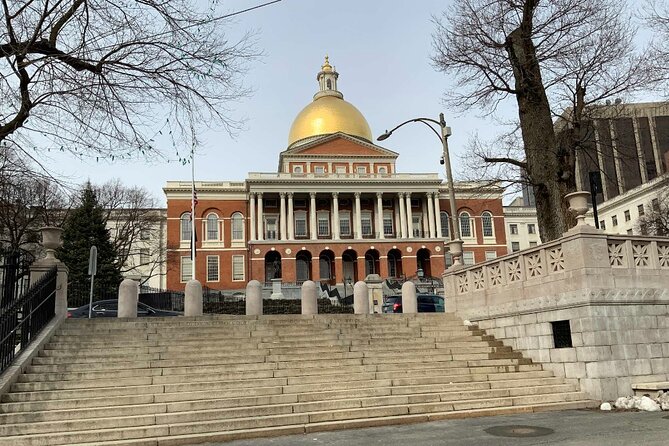
Brewer Fountain and the Massachusetts State House: civic Boston in gold and brick

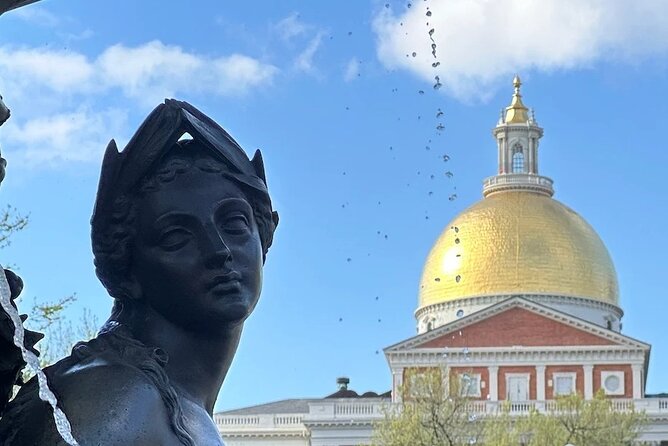
After the early Revolution chapters, the tour moves into civic territory. You stop at Brewer Fountain, then head toward the Massachusetts State House.
The value here is how the audio helps you read what you see. In photos, the Massachusetts State House can look like a single grand landmark. On foot, it starts to feel like the nerve center of the city’s decision-making. You also hear about Boston’s formation and what built the city into a political force.
This is a great time to slow down, because the route is changing tone. You are shifting from street-level rebellion to the big architecture of government and lawmaking. The contrast is satisfying. You see how power can look different depending on whether it is gathered in a meeting room, declared from a balcony, or carved into stone.
If you are photographing, this is where good light pays off. It is also a good moment to decide whether you want a snack break soon, since later stops include long-walk outdoor segments.
Gravestones that name the makers: Otis, Hancock, Revere, Adams
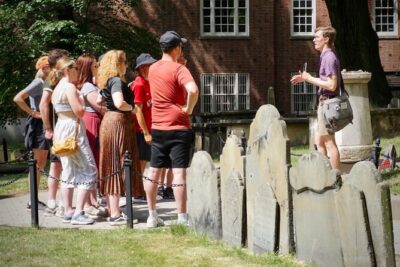
One of the most memorable parts of the route is the graveyard stop. The narration takes you through the character of Boston’s past as you read the stones and learn who rests there.
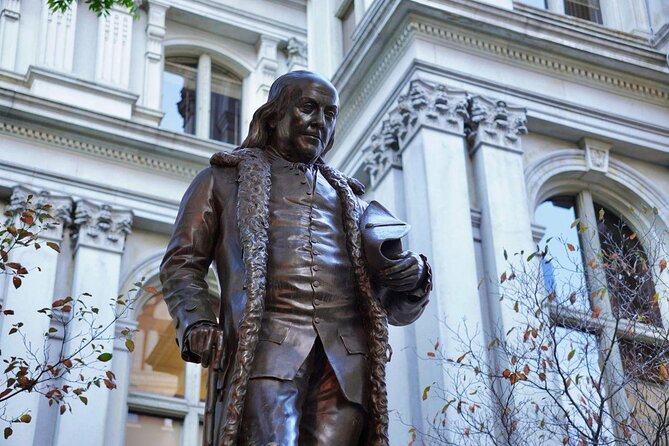
You will meet names like James Otis, John Hancock, Paul Revere, and Samuel Adams. That set is not random. It creates a sense of how many of the people shaping independence were tied to the same city. Listening while you walk gives the names more weight because you are not just reading labels, you are standing in the setting.
The tone here tends to feel quieter than the earlier street and meeting places. That is a good thing. A self-guided tour can become pure stamina if every stop is loud. This one lets you absorb.
Practical advice: wear shoes that handle uneven ground and bring a lens cloth if it is dry and dusty. Some graveyard stones can look better up close, and you will probably want a minute to frame the right shot.
Also, if you are traveling with people who want more minimal walking, you can often shorten your listening time at the start of this stop and still get the core story. The app format makes timing easier because you are not tied to a group schedule.
Old City Hall and the 1713 building: power, law, and trade
Your path includes Old City Hall, where you learn about the birth of the American legal system. That is a heavy subject, but the audio approach helps it stay grounded. You are walking through a place tied to legal thinking, not just a courtroom vibe in an abstract sense.
Right after that, you explore one of Boston’s oldest buildings, dating back to 1713, with a focus on Boston’s unique trading position. This stop is especially useful because it connects politics to economics. Independence did not grow only from ideals. It also grew from who controlled trade routes, who profited, and who got squeezed.
This is one of the reasons I like this tour style. It keeps reminding you that Boston is a trading port, a political hub, and a cultural city all at once. You can walk the story and see how business, law, and rebellion overlap.
If you are a museum lover, this is also a good place to decide whether you want to add a separate indoor stop. This tour does not include museum tickets, so you can branch based on your interests and still come back to keep listening.
Old South Meeting House and the practical breaks you will want
Next up is Old South Meeting House, described as the largest building in colonial Boston at one point and linked to planning for the Boston Tea Party. Hearing about the planning element matters. The Tea Party can sound like sudden vandalism if you only focus on the dramatic act. The audio frames it as coordination, timing, and political intent.
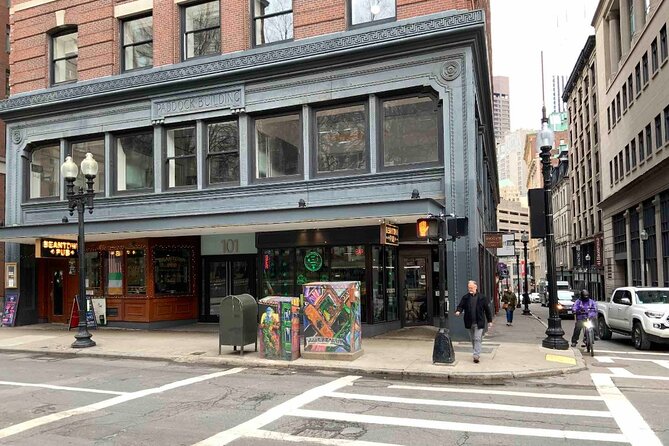
After that, the tour does something smart for real travelers: it includes a Beantown Pub refreshment stop and gives a clue that it is a Boston favorite where you can even find Sam Adams beer. You are not locked into this, but it is a helpful nudge. When you are walking for a couple hours, you will want at least one chance to sit, rehydrate, and reset your attention.
Since food and drink are not included, you can choose what suits you. But having the option built into the route means you are less likely to get to the final stretch tired and distracted.
If you do take a break here, treat it as a pacing tool. You can listen to the story segments with fresh energy instead of trying to push through the last bits while hungry.
The Irish immigrant chapter and the Boston Massacre scene
Two emotionally heavy stops come late in the route, and they are worth taking slowly.
First is the stop focused on Irish immigrants and the biological tragedy that forced them to leave their homeland for the unknown. The exact details are handled by the audio, but the takeaway is clear: migration is not always a choice. It is often survival. This section widens your view of what the Freedom Trail can mean. The trail is not just Revolutionary War drama. It is also how later waves of hardship and courage shaped the city.
Then comes the Boston Massacre area from 1770, where nine British officers faced a crowd of hundreds of people. The audio notes that five Bostonian lives were lost during this revolt.
This is one of the places where listening is better than reading alone. The crowd context, and the tension of the era, helps you imagine the fear and confusion that would have filled the street. When you stand there after hearing the story, the location feels less like a caption and more like a moment.
If you get emotional here, that is normal. This is one of those history stops that does not stay safely in the past.
The outdoor market finish and Copp’s Hill views toward USS Constitution and Bunker Hill
Your route includes the oldest outdoor market, which offers deals on fresh produce, fish, and flowers in the historic heart of the city. This stop gives you something different at the end: not a monument, but a living marketplace feel. It is a nice way to land after the intense story segments.
Then you finish at Copp’s Hill Terrace. One review detail I found particularly useful is that the tour guide ends at the view toward USS Constitution and Bunker Hill, rather than taking you to those exact locations. That matters for your planning. If you want to visit those sites too, you will need to add them separately after your walk.
If you finish with energy, the market stop and the terrace viewpoints are a good combo. If you finish a little tired, just enjoy the views, grab a snack, and call it a win.
Practical tips so you do not get lost or stuck on tech
A self-guided tour can fail for two reasons: you miss a turn, or the app stops working. Here is how to avoid both.
- Start with headphones tested. Make sure the volume is comfortable before you start walking.
- Expect occasional map quirks. One user said the map did not always track their exact position. If that happens, use the forward controls and keep going.
- Plan one flexible break. With the Beantown Pub stop in mind, you can pause without derailing the day.
- Begin mid-morning if you can. It keeps the walk in comfortable light and gives you time after the tour for other stops.
- Wear shoes for old streets. Freedom Trail sections involve varied sidewalks and stone. Comfort beats style here.
Also, remember the tour includes offline access to audio, maps, and geodata. That is the advantage. Still, you need your smartphone charged and ready.
Finally, keep your expectations realistic. This is not an in-person lecturer. It is audio guidance. You are the driver, and that is the appeal.
Should you book this self-guided Freedom Trail tour?
I think you should book it if you want the Freedom Trail story without the stress of a group schedule. The combination of lifetime access, offline audio and maps, and a narration style that people consistently praised makes it a strong value for solo travelers and couples.
I would skip or at least reconsider if you dislike tech dependence on a phone, or if you want someone to handle decisions in real time. Because audio is the main guide, you will need to manage your own pace and comfort.
If your ideal day is walking first, eating when it makes sense, and learning along the way through a clear narrative, this fits well. Get your headphones ready, save the battery, and enjoy the walk as one connected story from Faneuil Hall to Copp’s Hill.
FAQ
How long does the Freedom Trail self-guided tour take?
It is approximately 2 hours to 2 hours 40 minutes to complete.
What is the price per person?
The tour costs $14.99 per person.
Can I use it offline?
Yes. You get offline access to the audio, maps, and geodata.
Does the tour include museum tickets or entrance fees?
No. Tickets or entrance fees to museums or other attractions are not included.
Do I need my own smartphone and headphones?
Yes. A smartphone and headphones are not included, so you will need both.
Where does the tour start and where does it end?
It starts at 139 Tremont St, Boston, MA 02111 and ends at Copp’s Hill Terrace, 520 Commercial St, Boston, MA 02109.
Is this tour refundable if I cancel?
No. This experience is non-refundable and cannot be changed for any reason.
Written up lately around the harbor
- Boston’s Beacon Hill: Private Walking Tour
★ 5.0 · 1 review - Boston’s Chinatown: Small Group Walking Tour
★ 5.0 · 1 review - Self-Guided Scavenger Hunt: Boston Back Bay & Beyond
★ 4.0 · 1 review - Flynn Cruise Port Boston to Boston hotels – Arrival Private Transfer
★ 5.0 · 1 review - Boston to Woods Hole & Martha’s Vineyard Ferry Private Chauffeur Service
★ 4.0 · 1 review - Classic Martha’s Vineyard 1-Day Escape from Boston
★ 5.0 · 1 review - Private Vacation Photoshoot with Photographer in Boston
★ 5.0 · 1 review
Freedom Trail Tours, compared.
Freedom Trail History Small Group Walking Tour
Read our review →
Boston Freedom Trail Walking Tour with Costumed Guide
Read our review →
Boston Food & History: Pizza, North End & Freedom Trail
Read our review →
Boston’s Freedom Trail: A Revolutionary Walking Tour
Read our review →Freedom Trail History Small Group Walking Tour
Read our review →Boston’s Freedom Trail: A Revolutionary Walking Tour
Read our review →

Boston Freedom Trail History Pub Crawl Small-Group Tour
Read our review →Browse the lists this tour appears in